
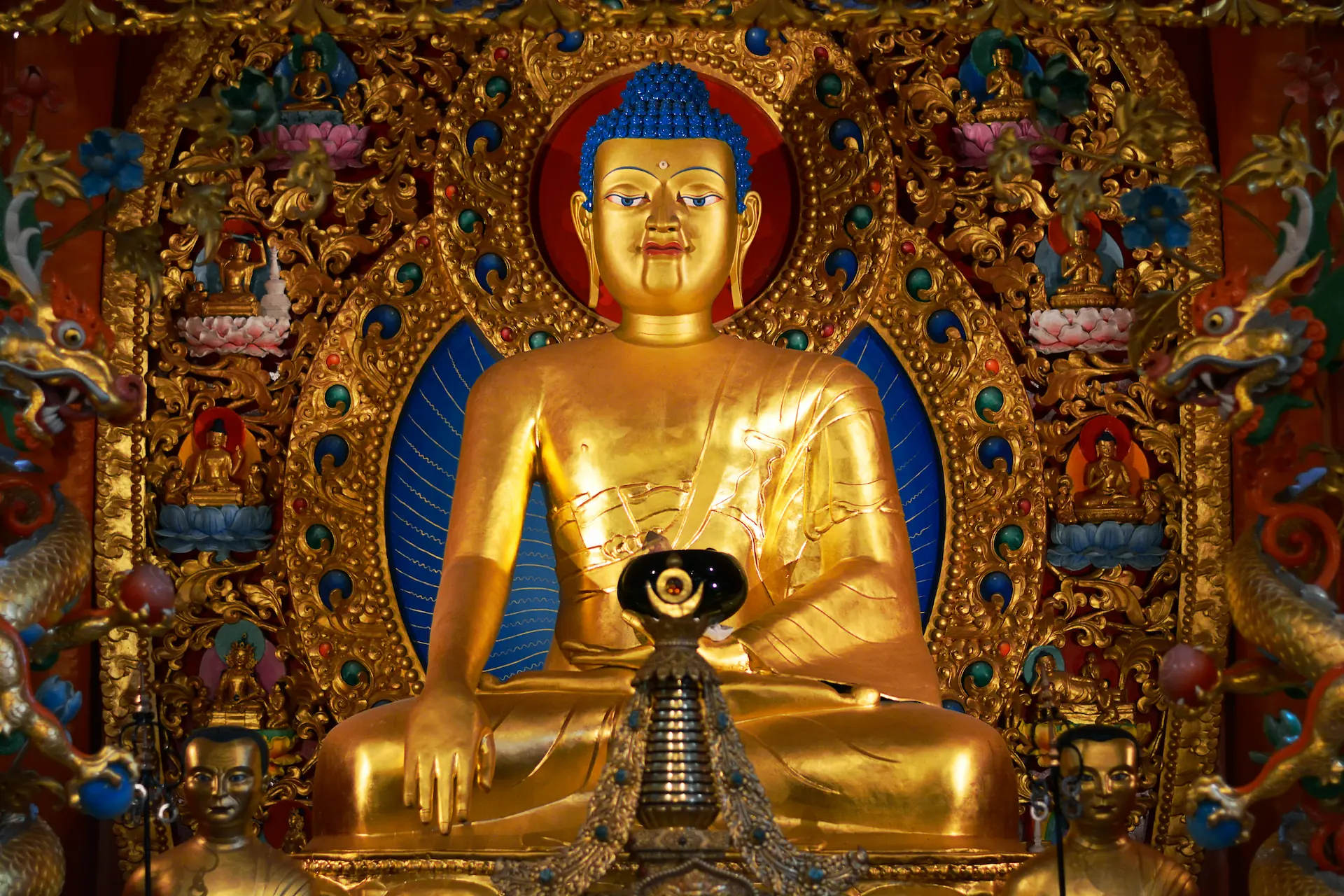
Buddha Shakyamuni statue in Samye Ling Main Temple
The Buddhist principle is to be everybody’s friend, not to have any enemy.
Choje Akong Tulku Rinpoche

Buddha Shakyamuni Thangka, Kagyu Samye Ling
The Path of The Awakened One
Buddhism
is a spiritual tradition that was founded over 2500 years ago during the time of Shakyamuni Buddha.
There are many different versions of the Buddha’s life, but they all tell of Prince Siddhartha, as he was then known, being profoundly moved by the suffering and apparent futility of life that he saw around him. He resolved to understand what caused suffering, how to free himself from it and so discover life’s true meaning.
Through concentrated meditation, he worked at overcoming many obstacles, both in the outer world and in his own mind. Eventually he experienced a deep and lasting realisation of the true nature of the mind and understood what caused unhappiness and suffering. This lasting awareness of ultimate truth is called ‘enlightenment’. It was at this point that he became known as the Buddha, which means the “Fully Awakened One”, because he had woken up to the true nature of existence.
Guide of All Beings
Following his enlightenment, the Buddha then spent 45 years teaching others how they too could attain freedom from suffering and experience lasting peace and happiness. Rooted in principles of non-violence and loving-kindness, his instruction set many people on the path to their own liberation. Among these were numerous disciples who committed the Buddha’s teachings to memory in order to pass them on to the generations that followed. These teachings became known as the “sutras”. In this way the Buddha’s wisdom and compassion have been transmitted down through the centuries and continue to help people to this day.
The essence of Buddhist practice:
1. Doing no harm
2. Performing wholesome actions
3. Training our mind through meditation.
CHANGE TO TEACHING SHAKYAMUNI

A Perfected Being, Not a God
Sometimes, people mistakenly think that Buddhists believe the Buddha to be a god. This is a misconception. The Buddha was a real man, albeit an exceptional one, who lived and died. He is revered because he undertook the very difficult task of understanding why there is suffering in the world. He succeeded in transforming his own suffering and awakening his wisdom and loving-kindness. In the process of doing this, he came to realize the true nature of things and to recognize that the only natural response to suffering is wise compassion.
But just as important is the fact that he then chose to devote the rest of his life to teaching others what he learned, so that they too could awaken wisdom and compassion in themselves and find lasting peace and happiness. So when Buddhists bow to a statue of the Buddha or say prayers, it is not because they think of the Buddha as a supernatural being who requires worship. Instead, they are simply showing deep respect for a great teacher and drawing their own inspiration and guidance from his teachings.
Innate Purity
One of the major differences between Buddhism and other religions is its perspective on the human condition. While it is common in many other traditions to regard a person as innately flawed or impure, and thus, the life’s task of that person is to seek redemption, the Buddhist tradition regards a person as naturally good and pure, and the life’s task of that person is to awaken this innate purity.
The Three Vehicles of Awakening
There are three different levels of Buddhist teaching and practice, each one forming the basis for the next. They are often called “vehicles” because they are the means for travelling the path to enlightenment.
Far from being opposing sects, the Hinayana (Basic Vehicle), Mahayana (Greater Vehicle), and Vajrayana (Indestructible Vehicle) are interrelated parts of a single body of teachings given by Shakyamuni Buddha over his lifetime. Within the Tibetan tradition, these have been preserved and passed down through the four main schools—Nyingma, Kagyu, Sakya, and Gelug—each tracing an unbroken lineage back to the Buddha himself.
Deepen Your Understanding
Hinayana
The path of renunciation, rooted in disciplined behaviour and ethical conduct. It teaches the Four Noble Truths and the Noble Eightfold Path as a means to free oneself from the suffering of samsara – the suffering of everyday life – which is also referred to as ‘the wheel of conditioned existence.’
Mahayana
The path of the Bodhisattva. A bodhisattva is a person who perceives the empty nature of all phenomena and cultivates the heart of great compassion, from which he aspires to free all living beings from suffering and guide them to complete enlightenment.
Vajrayana
The path of indestructible wakefulness. A special aspect of the Mahayana that uses skillful techniques such as visualisation and mantra to accelerate the path to enlightenment.
Meditation
Buddhist meditation aims to calm the mind and gain insight into its inner workings. By changing our habit from distraction to mindfulness and focus, this practice gradually transforms negative tendencies, enabling our innate wisdom and compassion to manifest fully in our lives.
The Kagyu Lineage
The Buddha’s teachings have always been passed down through an unbroken ‘lineage’ from teacher to student. Kagyu Samye Ling belongs to the Kagyu or ‘Practice Lineage,’ one of the four main traditions of Tibetan Buddhism, which emphasizes the direct experience of meditation and realization.
Dharma Study and Practice in Kagyu Samye Ling
Find out more about the Dharma activity taking place in Samye Ling. We welcome you to join us for daily practice sessions or take the excellent opportunity to generate merit during our annual prayer and retreat gatherings, and receive authentic Dharma teachings from learned visiting teachers.